Showing posts with label photography. Show all posts
Wednesday, June 10, 2009
Black and White Film
These are some photos I shot using black and white film. This was my first experience developing pictures in a darkroom, and it was great! The film scanner to which I have access is broken, so most of these pictures were scanned from prints...not ideal, of course, but I'm just not going to worry about it today.


Labels:
2701,
class,
halls,
photography,
Photography I,
University of Memphis,
windows
Wednesday, April 8, 2009
On Photography by Susan Sontag
I read On Photography by Susan Sontag and wrote a book review for it. In case you're looking for a good read, I highly suggest it. Watch out, though, it's not exactly brain candy. Here's my review:
Susan Sontag’s message throughout On Photography is that photography, above and beyond previous attempts from the traditional fine arts, has exposed the underbelly of our humanity by completely redefining how we visualize and experience the world. We are greedy voyeurs of the mundane, deformed, sordid, alluring, gorgeous and transcendent qualities of the human race; all aspects, good and bad, are rendered glorious and true through the camera lens. Although each essay is based on a different theme, this concept is artfully weaved throughout the text.
The reason that humanism has become the reigning ideology of ambitious professional photographers – displacing formalist justifications of their question for beauty – is that it masks the confusions about truth and beauty underlying the photographic enterprise. - Susan Sontag
Susan Sontag’s message throughout On Photography is that photography, above and beyond previous attempts from the traditional fine arts, has exposed the underbelly of our humanity by completely redefining how we visualize and experience the world. We are greedy voyeurs of the mundane, deformed, sordid, alluring, gorgeous and transcendent qualities of the human race; all aspects, good and bad, are rendered glorious and true through the camera lens. Although each essay is based on a different theme, this concept is artfully weaved throughout the text.
In the essay entitled “In Plato’s Cave,” Sontag describes photographs as cheap, ephemeral, dirty little things: they can be bought, sold, tacked up. Photography enlarges our field of view, allowing us to inventory the world in books and brains and raises the issue of what Sontag calls the “ethics of seeing.” To photograph something or someone is to appropriate it, which is a subtle act of aggression. I felt this myself as I took pictures of some travelers in the Detroit airport. I stole something from them that they didn’t have of themselves; some seemed nervous, a few angry, and all of them uncomfortable that I was “taking” a photograph of them (or another appropriate term in this context: “shooting” them). Sontag might have described this as a form of rape. A tad melodramatic, perhaps, but I get her point. I must admit that I probably felt just as uncomfortable as my subjects during our brief, anonymous union. The only thing that kept me from running in the other direction was that I had the luxury of hiding behind the camera.
Sontag compares two collections that both universalize the human condition in their own way: Family of Man and the work of Diane Arbus. The former is a collection of photographs from around the world curated by Edward Steichen that essentially boils down the entire human race into a joyful “one.” Arbus represents the polar opposite: by capturing the grotesque, awkward, and suffering side of humanity, she seeks to show that our commonality is found in our aloneness.
She spends quite a bit of time discussing Arbus’s work, and I initially found this irritating because she seems to focus on a “fashionably pessimistic” body of work (as she later describes Michael Lesy’s Wisconsin Death Trip). Having never previously spent time viewing Arbus’s work, I paused to do so. Upon reflection, these images are far from pessimistic; these people are inspiring in that most of them seem perfectly content with their lot. I realize that Arbus’s circus freaks, kids in awkward contortions, and midgets form a collective representing that side of humanity brought forth uniquely through photography, hence the appropriateness of Sontag’s musings. I can imagine the softly lit images of new mothers nursing their babies in The Family of Man by Nell Dorr and Wayne Miller (accompanied by the caption “And shall not loveliness be loved forever?” Euripides) formed out of canvas and oil paint, but Arbus’s Child with a Toy Hand Grenade in Central Park would lose its rhetorical power in any other medium than photography.
I am intrigued that she thinks that Arbus is not asking the viewer for a compassionate response when looking at her photographs. If that is true – and if it is also true that these photographs represent aspects of Arbus herself – I wonder if it is an underlying pride and fierce courage that she rejects this compassion? I wonder this simply because this is what I want for her subjects when I view her portraits (either that or obliviousness to us). They are not desperate rejects of society that shudder under our scrutiny, and I feel so grateful that it does not seem to occur to them that they even need my compassion. Is this because I see myself in them as well?
Sontag broaches the relationship between subject matter and content as well as the notion of beauty in “Melancholy Objects” and “The Heroism of Vision.” She feels that surrealism triumphs in the realm of photography and that this movement (along with what she calls the “true modernism” of the new, ephemeral and junky) is the crushing blow to Walt Whitman’s dream of cultural renewal in the United States. Unlike the traditional fine arts, the key to a photograph’s subject matter isn’t always related to its content. In fact, photography subverts traditional content by finding truth and beauty in eyesores, trash, and the mundane. The physical artifact of a photograph itself satisfies the criteria she sets forth for a surrealist agenda: common and inexpensive. Less is more.
This historical lesson on surrealism is particularly enlightening to me. I am drawn to the beauty of subjects commonly portrayed in the traditional fine arts along with everyday artifacts brought to life through the camera. Although this is obviously not a distinctive or remarkable asset, I’ve noticed a rejection of traditional subject matter in photography and have sometimes viewed that trend as a bit tiresome when seemingly done for its own sake. It is gratifying to learn a bit about the movements that alter the ebb and flow of trends in the field of photography. In representing multiple facets of human nature, not all images need – or should – be traditionally beautiful, expertly rendered, and well placed as in a painting. Quite the opposite, in fact.
Sontag doesn’t consider photography to be an art form, comparing it to a medium like language “in which works of art (among other things) are made. Out of language, one can make scientific discourse, bureaucratic memoranda, love letters, grocery lists, and Balzac’s Paris. Out of photography, one can make passport pictures, x-rays, wedding pictures, and Atget’s Paris.” Her statement intrigues not because I disagree with her (and I do), but because she entreats photographers to understand what they bring to the table. Do not photograph “meaningless” objects because others have done so; great photographers have their own vision and agenda behind their work. I think she’s saying that a photograph with no intent can easily be reduced to, say, a passport picture: a useful object with no artistic value. Conversely, a passport picture taken with intent has the potential to transcend its status as object.
Susan Sontag is a profoundly gifted writer. To borrow her favorite poor descriptor for photographs, her essays are “deceptively simple.” This is an incredibly rich text in that every word is chosen with care; extremely complex ideas backed up by a wide breadth of disciplines are delivered as concisely and meaningfully as possible. I walk away from the book confident that I grasp her main ideas, but later I get that I’ll need to read this again (and again?) to tease out the layers of issues she has presented to us. As a collection of timeless critical essays probably should do, she presents deeply provocative issues and lets her readers sort out for themselves what to take from and think about them.
Friday, March 13, 2009
Photography channel coming?
Looks like there will be a TV network solely devoted to photography. How cool! Here's a blurb from their site:
Photography is the universal language spoken in every country around the world. Now everyone can share their vision and passion by connecting with the hearts and minds of photographers everywhere.
Check out their web site for a video explaining their concept.
Thursday, March 12, 2009
Rogue wedding photographer?
Last weekend I shot some photos for my cousin's wedding at the Hernando Hills Country Club. Here are a few of my favorites.


Wednesday, February 25, 2009
Ed Kashi
Ed Kashi wrote an article for liveBook's new blog, Resolve, describing his experiences teaching a National Geographic Photo Camp in India. I especially liked what he had to say about the educational role photography plays within a global context:
I believe strongly in the power of photography to teach, to raise awareness, and to intimately and dramatically bring to life our stories, our issues, and our subconscious concerns. I have witnessed this power in countless situations, including refugee camps in Uganda, rural villages of Oaxaca, Mexico, the Latino district of San Francisco, and the South Bronx. These are the other National Geographic photo camps I’ve been a part of, but beyond this one set of experiences, I’ve been reminded repeatedly that photography has an uncanny, unique power to inspire, to prick the questioning mind, to discover beauty, and to express the intimate and personal.
It is this nexus of passion for, belief in, and commitment to the unique universe of visual storytelling that compels me to keep on driving forward, moving against the current odds, the dire predictions and blatant economic and structural trends. I cannot stop, nor do I believe I should. There is a usefulness, potency, and necessity to photography.
I believe strongly in the power of photography to teach, to raise awareness, and to intimately and dramatically bring to life our stories, our issues, and our subconscious concerns. I have witnessed this power in countless situations, including refugee camps in Uganda, rural villages of Oaxaca, Mexico, the Latino district of San Francisco, and the South Bronx. These are the other National Geographic photo camps I’ve been a part of, but beyond this one set of experiences, I’ve been reminded repeatedly that photography has an uncanny, unique power to inspire, to prick the questioning mind, to discover beauty, and to express the intimate and personal.
It is this nexus of passion for, belief in, and commitment to the unique universe of visual storytelling that compels me to keep on driving forward, moving against the current odds, the dire predictions and blatant economic and structural trends. I cannot stop, nor do I believe I should. There is a usefulness, potency, and necessity to photography.
Labels:
ed kashi,
education,
national geographic,
photographer,
photography,
travel
Thursday, February 19, 2009
Scanner Madness
In an effort to post some photos using my Nikon N70 film camera, I decided to take advantage of the super-snazzy film scanner at school today. I walked into the lab feeling confident in my embrace of modern technology (after spending hours in a medieval darkroom developing the film to be scanned, that walk felt like a time warp to the future). Unfortunately, this wonder of modern technology had a ragged sheet of copy paper taped to it stating "Broke - do not use."
The other available scanner is a flat-bed style that can be rigged up to scan film, but not easily. Well, at least I couldn't figure it out after messing with it for an hour and a half. This is a test strip I used to see if I could get the darned thing to work.
It took so long to do this I feel compelled to post it. Phew! I took these shots as part of an assignment in capturing "light." That was the extent of the explanation of the assignment; it was our job to interpret that as we like. These are not my favorites, but I kind of like them as a triptych...plus, this really took forever! I'm keeping my fingers crossed that they fix the decent scanner!
The other available scanner is a flat-bed style that can be rigged up to scan film, but not easily. Well, at least I couldn't figure it out after messing with it for an hour and a half. This is a test strip I used to see if I could get the darned thing to work.
It took so long to do this I feel compelled to post it. Phew! I took these shots as part of an assignment in capturing "light." That was the extent of the explanation of the assignment; it was our job to interpret that as we like. These are not my favorites, but I kind of like them as a triptych...plus, this really took forever! I'm keeping my fingers crossed that they fix the decent scanner!
Saturday, February 14, 2009
Looking In
As I'm getting more familiar with the process of shooting, developing, and printing film photography, I can't help but notice that there is some creative leverage found here that is difficult to duplicate in digital photography. What I'm mostly talking about is found in the printing process. Ever seen an old photograph with some rough, wavy lines around the image? That's what happens in the printing process when you expose a negative to photo paper and don't crop it. It is a fantastic way to frame some photos (depending on the subject matter).

Another thing I love is a contact sheet. When using 35 mm film, you can line up multiple negatives, side by side, and expose them onto light-sensitive photo paper to yield "thumbnail" prints. This is a quick and dirty way to see which photos you will eventually want to enlarge and print.
Something that's cool about contact sheets is that they can tell a story in chronological order from exposure 1 to 36. When I decided to go shoot some pictures the other day, where did I go? What was I drawn to? They are their own special kind of narrative. And, although they're just a step in the process, I think they are strangely beautiful on their own. Speaking of: NPR just published an article about a just-released catalog entitled Looking In: Robert Frank's 'The Americans.' It chronicles the 83 images currently on display at The National Gallery of Art in Washington, D.C. of his full-fledged photographic series The Americans (first and fully published in 1958).
According to NPR: "It's sacrilege to say, but perhaps even more revelatory than the 83 photographs themselves are Frank's contact sheets, a frame-by-frame record of the images snapped on his sprawling journey. Filling 81 pages of Looking In, they not only provide a thrilling and rare insight into the shaping, through masterful editing, of images into art, but they also reveal how a great photographer sees - in this case, directly into the soul of America."
About the photographer in general, they go on to say: "His images perfectly capture the new America: a flag-draped memorial to Honest Abe; celebrity-worshippers at a glitzy premiere; Windy City operators huddled in political deal-making; the empty chairs and desks where bank-loan officers and aspiring homeowners once sat; couples clutching in hope and love and uncertainty on public lawns.
It's evidence both of the cycles of American life and the timelessness of photographer-filmmaker Robert Frank's art that a half century after the debut of his ground-shifting book The Americans, so many of its brazen, coarsely poetic pictures still frame our national experience."

"Guggenheim 340/Americans 18 and 19 - New Orleans 11/1/1955" - Frank shot this roll of film in New Orleans in November, 1955. It contains two images, numbered 13 and 16 in the row outlined in red, that made Frank's final cut for The Americans. Photo number 16, "Trolley - New Orleans," became famous as The Americans' cover image.

Labels:
35mm,
contact sheet,
film,
looking in,
photography,
robert frank,
the americans
Monday, February 9, 2009
Doris adoration.
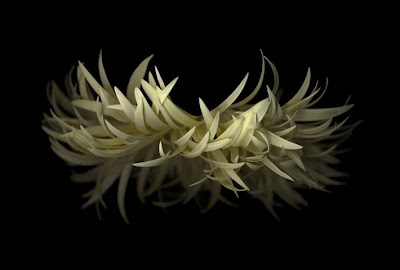
For anyone that doesn't know, I adore Doris Mitsch's work. I first noticed it during my time at International Paper. A competitor printed a stunning, perfect-bound book displaying her gorgeous photographs on their gorgeous paper. I smuggled it home from the printer that made the mistake of showing me the piece and, occasionally, I'll pull it out and drool for a few minutes.


Instead of using a camera, she uses a flat-bed scanner. I haven't done this yet, but at some point I'm going to pull myself together and try it out. I have a feeling it is much harder than it sounds. For instance, a flat-bed scanner is...flat. How does she get all that dimension if the subject is smashed against a piece of glass?
Exactly. I have no idea. When I find out, I will definitely post the answer.
Here are some of her beautiful images and a link to her site:


Tuesday, November 18, 2008
Key West anniversary trip
Monday, November 10, 2008
Key West

George and I were married on November 11, 2007, in Key West at the Hemingway House. We needed little justification to return a year later to celebrate our one year anniversary. So, right now, I am sitting on the deck of the Avalon Bed and Breakfast on south Duval Street, having coffee and watching the colorful passersby on their way to the beach, a leisurely brunch, a drag show - there are a refreshingly wide array of offerings in this town even in the early AM.
Yesterday, we visited the Hemingway House and took pictures of the six-toed kitties lazing about the property. We were thrilled to find the wonderful lady who officiated our wedding ceremony, Linda Mendez, behind the counter at the gift shop. My photographer and hair stylist described her separately as "salt of the earth, " and I must say this is an apt description. Laid back and tanned to leathery perfection, this Minnesota transplant now happily considers herself a Key West local after 25 years. A year ago this month, I was calling her on a weekly basis with a check list of questions that seemed vital at the time but I know now are just plain annoying: "If the cake is delivered at noon will it sit in the sun or do you have a fridge?" "Will you have Sprite for the kids???" "How long will the musician hang around? We paid for an hour but do we need two?" She not only answered my questions with the patience of a saint, she also managed to calm me down and the only person more manic than me at the time, my mother. She may not know this, but WE LOVE LINDA.
She's the lady front and center in the picture taken one year ago from today.
I'll follow later with pictures of my trip!
She's the lady front and center in the picture taken one year ago from today.
I'll follow later with pictures of my trip!
Sunday, November 2, 2008
Subscribe to:
Posts (Atom)